
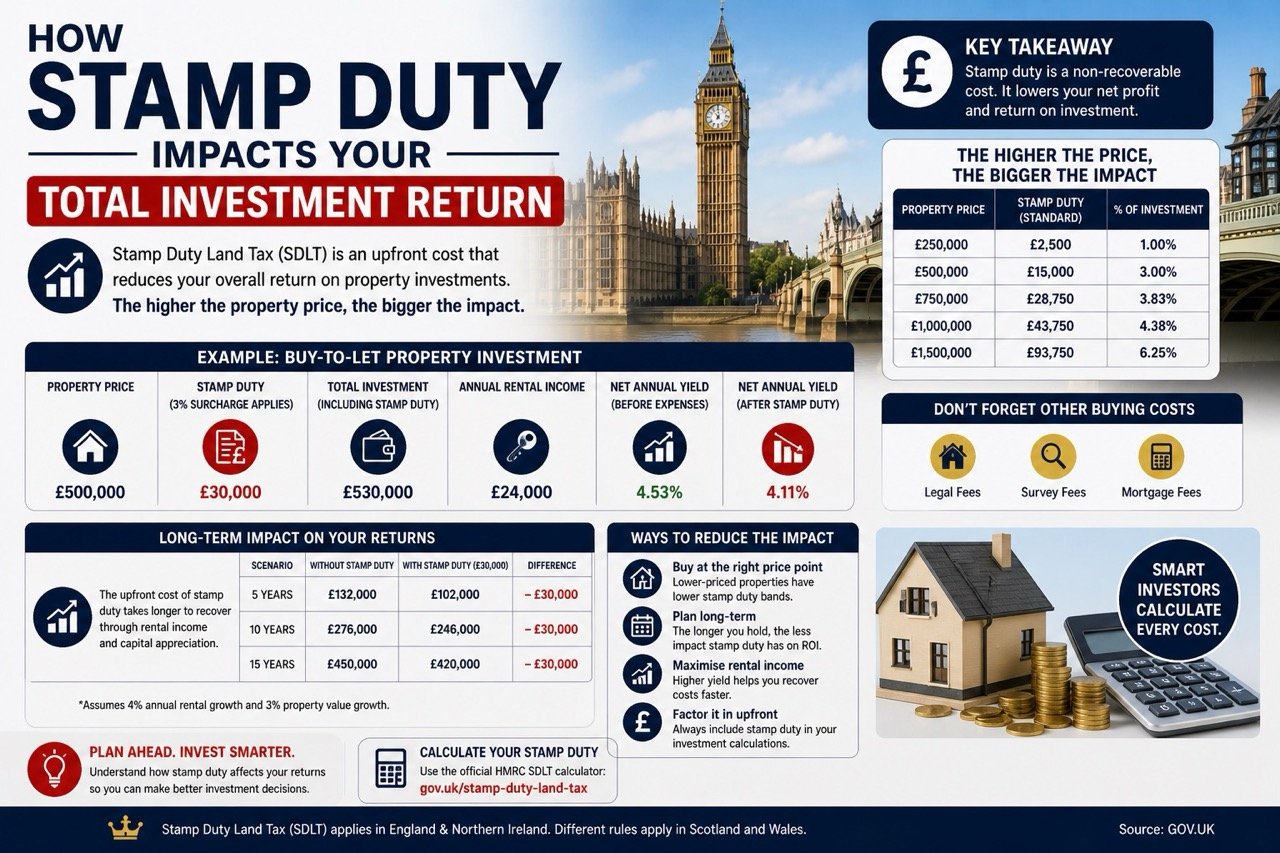
Stamp duty investment return is a critical factor that many investors overlook. Most buyers focus on property price and rental income. However, stamp duty directly affects your overall profit. Because of this, understanding its impact is essential before investing.
How stamp duty investment return works
Stamp duty is an upfront cost. Therefore, it reduces your initial return immediately.
In addition, this cost does not generate income. Because of this, it lowers your overall investment efficiency.
For example, if you pay a high amount of stamp duty, your return percentage decreases. Therefore, even a good property may become less attractive.
Investors who analyse UK housing supply and demand statistics often include tax costs in their strategy.
Stamp duty investment return and total costs
Impact on initial investment
Stamp duty increases your total purchase cost. Therefore, your capital invested becomes higher.
Because of this, your return on investment becomes lower compared to the same property without tax.
Many buyers explore property for sale in London to compare total investment costs before buying.
Effect on yield
Rental yield is calculated based on total investment. Therefore, higher stamp duty reduces your yield.
Because of this, investors must consider tax when calculating expected returns.
Buyers often review London property price trends and data to estimate realistic returns.
Long term effect of stamp duty investment return
Recovery over time
Stamp duty is paid once. However, its impact lasts long term.
Because of this, investors rely on capital growth and rental income to recover the cost.
In addition, properties in strong locations recover faster. Therefore, location becomes even more important.
Importance of holding period
Short term investors feel the impact more. However, long term investors can offset stamp duty over time.
Because of this, holding property longer improves overall returns.
Financial factors linked to stamp duty investment return
Interest rates and borrowing costs
Interest rates affect your financing costs. Therefore, combined with stamp duty, they influence total return.
Because of this, investors monitor UK interest rates and mortgage updates carefully.
Market conditions
Market growth helps recover stamp duty faster. Therefore, buying in a strong market improves outcomes.
Because of this, timing and location both matter.
How to reduce the impact of stamp duty investment return
Choose the right property
Properties with strong growth potential perform better. Therefore, they recover stamp duty costs faster.
Because of this, investors focus on regeneration areas like London, Stratford and London, Woolwich.
Plan your investment strategy
A clear strategy helps manage costs. Therefore, investors should include stamp duty in their calculations from the start.
Because of this, they avoid overestimating returns.
Timing your purchase
Market conditions can affect overall investment performance. Therefore, timing plays a role in reducing impact.
Buyers who research when is the best time to buy off plan property often improve their entry point.
Reviewing search results for London properties helps compare options based on total investment value.
Common mistakes investors make
Ignoring stamp duty in calculations
Some investors calculate returns without including stamp duty. However, this gives inaccurate results.
Because of this, they may invest in less profitable properties.
Focusing only on short term gains
Short term thinking increases the impact of stamp duty. Therefore, investors should focus on long term growth.
Because of this, they can recover costs over time.
Final thoughts on stamp duty investment return
Stamp duty investment return is a key factor in property investment. It directly affects your profitability.
Therefore, understanding its impact helps you make better decisions.
Because of this, investors who plan carefully achieve stronger long term returns.



Join The Discussion