
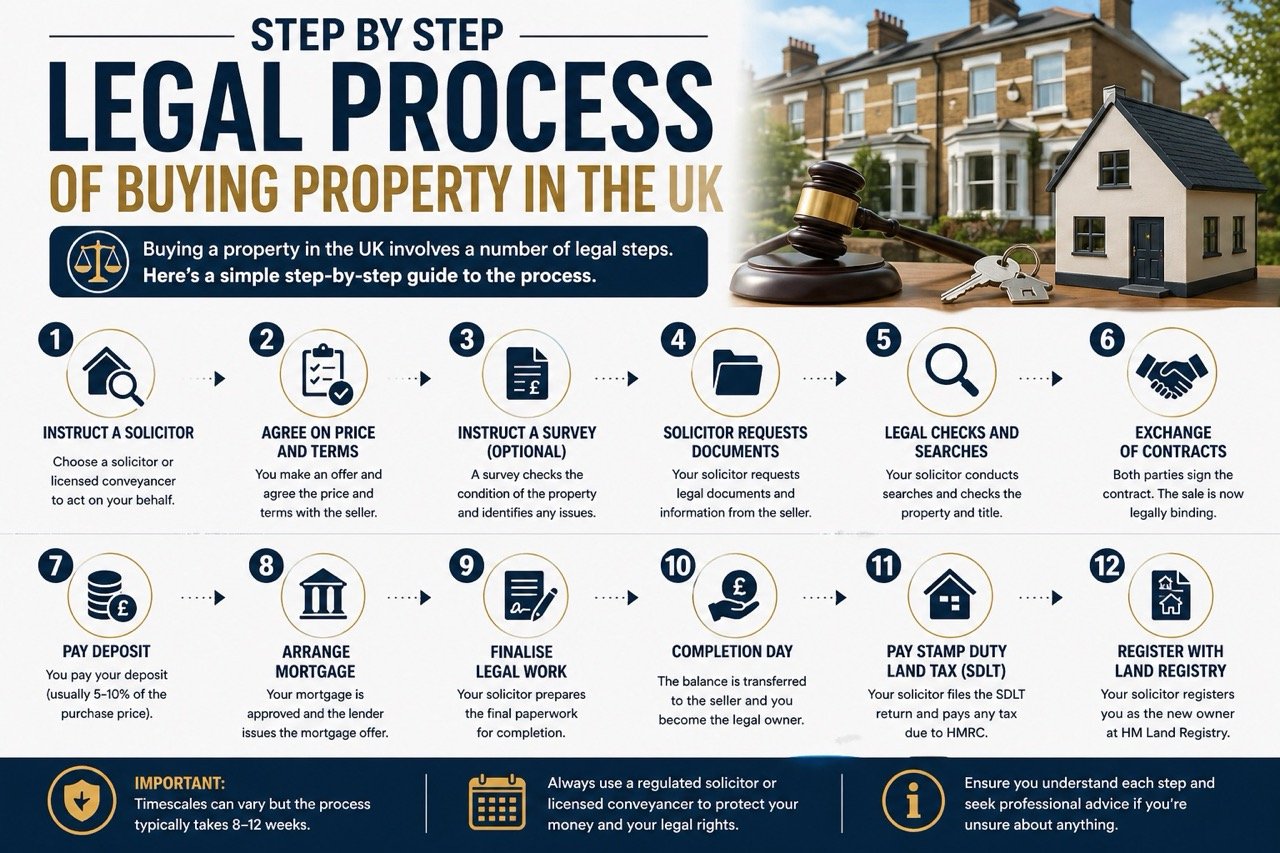
Property buying process UK can feel confusing at first. However, each step becomes easier when you understand the legal journey. In England and Wales, the process usually includes making an offer, conveyancing, paying tax, and registering ownership. GOV.UK says buying a home takes about five months on average, although chains can make it longer.
Property buying process UK explained
The legal process starts before you choose a property. First, you should understand your budget. Then, you should check your mortgage position and extra buying costs.
In addition, you need to prepare proof of funds. Solicitors and estate agents may also ask for identity checks. Therefore, early preparation helps avoid delays.
Many buyers explore property for sale in London before choosing a final location.
Step 1, make an offer
Once you find the right property, you make an offer through the estate agent. If the seller accepts, the legal process begins.
However, the property is not legally yours yet. In England and Wales, the agreement only becomes legally binding after exchange of contracts.
Step 2, instruct a solicitor
Why conveyancing matters
Your solicitor or licensed conveyancer handles the legal transfer of ownership. This stage is called conveyancing. GOV.UK lists conveyancing as one of the main steps in buying a home.
Your solicitor checks the contract, title, searches, and legal documents. Therefore, this step protects you from hidden problems.
Buyers often review UK housing supply and demand statistics to understand the market before committing.
Step 3, arrange mortgage and survey
If you need finance, your lender will assess the property. They may also carry out a valuation. However, this is not the same as a full survey.
A survey helps you understand the condition of the property. Therefore, it can protect you from unexpected repair costs.
In addition, mortgage costs can change with interest rates. Buyers should follow UK interest rates and mortgage updates before making final decisions.
Step 4, searches and legal checks
Your solicitor orders searches. These may include local authority searches, drainage checks, and environmental searches.
Because of this, you can understand planning matters, roads, flood risk, and other legal points.
In addition, your solicitor checks the title. This confirms whether the seller has the right to sell the property.
Step 5, exchange contracts
Exchange of contracts is a major legal step. At this point, both buyer and seller become legally committed.
Usually, you pay a deposit at exchange. Therefore, you must be fully ready before this stage.
Buyers who research when is the best time to buy off plan property often understand timing and contract risks better.
Step 6, completion day
Completion is when the remaining money transfers to the seller. After that, you receive the keys.
Your solicitor also handles final payments. This can include legal fees, mortgage funds, and tax payments.
Step 7, pay stamp duty
Stamp Duty Land Tax may apply when buying property in England or Northern Ireland. GOV.UK states that SDLT starts to apply above certain thresholds, including £125,000 for residential property and £300,000 for eligible first time buyers buying a property worth £500,000 or less.
However, rates can change. Therefore, you should always check the latest rules before buying.
Step 8, register ownership
After completion, your solicitor registers the property with HM Land Registry. Registration gives official proof of ownership and helps protect the property from fraud.
In addition, you can update contact addresses on the register. HM Land Registry allows up to three contact addresses, including an email address.
Reviewing search results for London properties can also help buyers compare options before starting the legal process.
Final thoughts on property buying process UK
Property buying process UK becomes easier when you follow each step carefully. Therefore, preparation is very important.
However, every purchase is different. Because of this, buyers should use qualified legal advice and avoid rushing important decisions.


Join The Discussion