
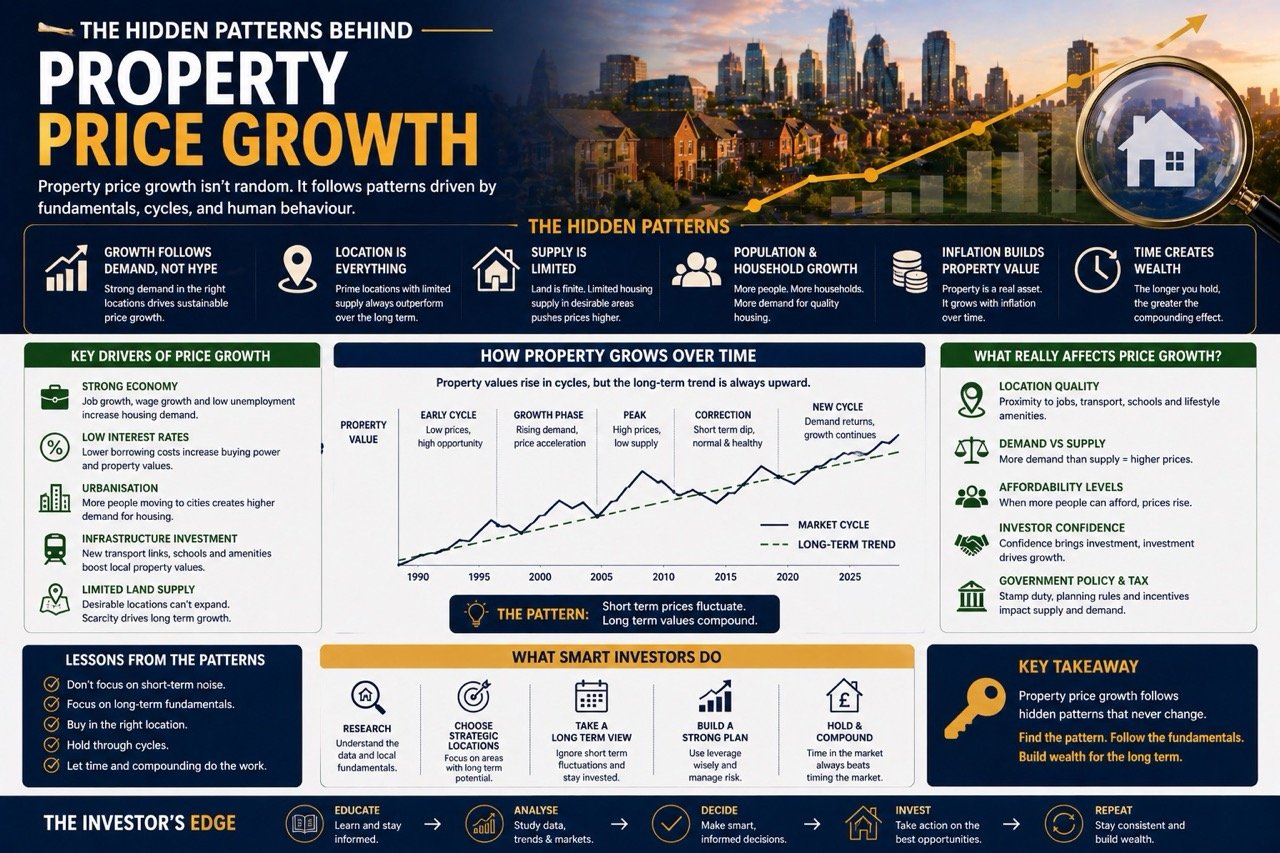
Property price growth patterns are not random. Many investors think prices move unpredictably. However, there are clear patterns behind every market shift. Because of this, investors who understand these patterns can make better decisions.
How property price growth patterns really work
Property markets follow cycles. These include growth, peak, slowdown, and recovery. Therefore, prices rise and fall over time.
In addition, external factors influence these movements. These include interest rates, supply, and demand. Because of this, understanding patterns becomes essential.
Investors who analyse UK housing supply and demand statistics often identify these trends early.
Property price growth patterns and location
Growth starts in key areas
Property price growth usually starts in prime areas. However, it does not stay there.
Over time, growth spreads to nearby locations. Therefore, surrounding areas begin to increase in value.
For example, areas like London, Stratford and London, Woolwich have benefited from regeneration. Because of this, they show strong growth patterns.
Many buyers explore property for sale in London to identify these emerging locations.
Infrastructure drives growth
Transport and infrastructure play a major role. When new connections are introduced, demand increases.
Because of this, property prices often rise in well connected areas. Therefore, investors focus on locations with future infrastructure plans.
Economic factors behind property price growth patterns
Interest rates and affordability
Interest rates directly affect buying power. When rates are low, more people can buy property. Therefore, demand increases.
However, when rates rise, affordability decreases. Because of this, price growth may slow down.
Smart investors monitor UK interest rates and mortgage updates to understand these changes.
Supply and demand imbalance
When demand is higher than supply, prices rise. However, when supply increases, growth slows.
Because of this, areas with limited new development often see stronger price growth.
Investors also review London property price trends and data to track these movements.
Behaviour patterns of buyers and investors
Market sentiment
Buyer confidence plays a key role. When confidence is high, demand increases quickly.
However, during uncertainty, buyers hesitate. Because of this, price growth slows.
Investor activity
Investors often move in early. They identify growth areas before the wider market.
Therefore, their activity creates early price increases. As a result, these areas become more attractive over time.
How to use property price growth patterns
Identify growth early
Understanding patterns helps investors act early. Therefore, they can buy before prices rise significantly.
In addition, they focus on areas with regeneration and infrastructure plans.
Buyers who research when is the best time to buy off plan property often use these patterns to improve timing.
Combine data with strategy
Patterns alone are not enough. They must be combined with a clear strategy.
Because of this, investors should define their goals and risk level.
Reviewing search results for London properties helps compare opportunities across different areas.
Long term view on property price growth patterns
Over time, property prices tend to increase. However, short term fluctuations are normal.
Because of this, investors should focus on long term trends rather than short term changes.
In addition, patience allows investors to benefit from full growth cycles.
Final thoughts on property price growth patterns
Property price growth patterns provide valuable insights. They show how markets move and where opportunities exist.
Therefore, investors who understand these patterns can reduce risk and improve returns.
Because of this, learning these patterns is essential for long term success.


Join The Discussion